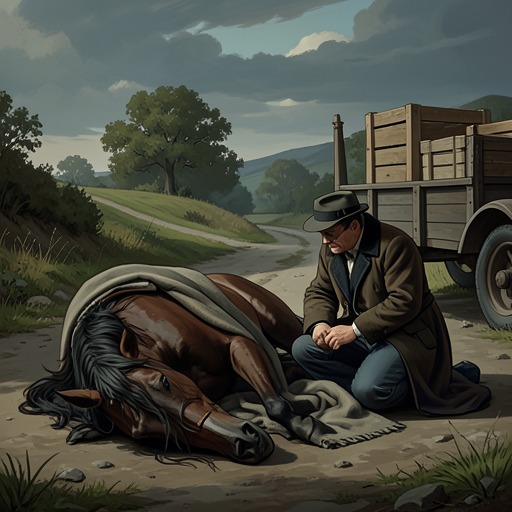
Thoroughgood Buys and Nurses Black Beauty Back to Health
Black BeautyMr. Thoroughgood Buys and Nurses Black Beauty Back to Health is the turning point from apparent ruin to recovery in Black Beauty’s working life. After a collapse brought on by overwork, a sale places him among worn-out horses, but Mr. Thoroughgood looks beyond his thinness to the signs of a sound horse beneath it. His grandson Willie helps persuade him to risk five pounds; patient care restores Black Beauty sufficiently for gentle work, though the account ends with the family still seeking a suitable place for him.
From Collapse to the Sale
The rescue follows Black Beauty’s collapse on Ludgate Hill, where the heavy load and his exhaustion overcame him despite the driver’s continued urging. He was taken to nearby stables and given a warm, well-littered stall and gruel. By evening he could be led back to Skinner’s stables. The next morning a farrier judged that the problem was overwork rather than disease: with six months away from work, Black Beauty might be able to return, but he had no strength left at that moment. Skinner ordered that he be fed and cared for, although the account presents the order as reluctant. The stable man carried it out more willingly.
For ten days Black Beauty received rest and plentiful oats, hay, bran mashes, and boiled linseed. The food and respite began to improve his condition, making life seem possible again after the prospect of being discarded. On the twelfth day after the accident, however, he was taken to a sale a few miles outside London. There he found himself among horses described as lame, broken-winded, old, or otherwise worn down. The scene places his sale within a broader trade in animals whose remaining value was weighed against the cost of keeping them: poor buyers sought horses for small carts, while sellers tried to obtain a few pounds for exhausted animals.
Willie’s Recognition and the Purchase
Mr. Thoroughgood arrived with Willie and paused to look over the horses. Black Beauty still had a good mane and tail, and when the farmer’s attention rested on him, he pricked his ears and looked back. Mr. Thoroughgood recognized that his features and build suggested breeding and that the horse had once been useful in better circumstances. Willie, in turn, noticed how Black Beauty responded to a kind touch. He urged his grandfather to examine the horse more closely, arguing that he might not be as old as his appearance suggested and could improve in the family’s meadows.
The seller reinforced the boy’s case by explaining that Black Beauty had been pulled down by overwork in the cabs, not simply by age. He reported that a veterinary opinion favored six months’ rest and that Black Beauty had been pleasant to handle during the preceding ten days. Mr. Thoroughgood examined his legs, which were swollen and strained, and looked at his mouth; he estimated the horse’s age at thirteen or fourteen. Black Beauty was then trotted out despite his stiffness. The seller asked five pounds, the minimum set by his master. Mr. Thoroughgood considered the purchase a speculation, but counted out the money. The decision joins practical uncertainty to a willingness to give the horse the chance Willie sees in him.
Rest, Care, and Recovery
After the purchase, Black Beauty was fed at an inn and gently ridden home by a servant. He was turned into a large meadow with a shed. Mr. Thoroughgood ordered hay and oats morning and evening and allowed him the run of the meadow during the day. He also placed Willie in charge of overseeing him. Willie took that responsibility seriously: he visited daily, found Black Beauty among the other horses, brought him a piece of carrot or another treat, and stayed beside him as he ate. His regular visits and affectionate attention formed part of the new horse’s settled routine, and Black Beauty grew fond of him, following him about the field and receiving the name Old Crony.
Mr. Thoroughgood continued to watch Black Beauty’s legs and cautiously assessed his progress. The farmer attributed improvement to complete rest, good food, soft turf, and gentle exercise. Black Beauty also had a better chance of recovery because he had a strong constitution inherited from his mother and had not been strained while young. Over the winter his legs improved and he began to feel young again. In March, Mr. Thoroughgood tried him in the phaeton. Black Beauty was willing, and he and Willie drove him a few miles; his legs were no longer stiff, and he managed the work with ease. The trial was evidence of recovery, not a return to hard labor: Mr. Thoroughgood proposed only a little gentle work, believing that by mid-summer Black Beauty might be as good as Ladybird.
Meaning and Immediate Outcome
The episode reverses the verdict implicit in the sale. At first, Black Beauty’s thinness and strained legs place him among horses treated as nearly used up; close attention to his bearing, mouth, and response to kindness reveals a different possibility. The recovery does not come from a single remedy but from a change in conditions: rest replaces work, suitable food replaces mere maintenance, and meadow exercise replaces confinement to labor. The narrative thus gives the farrier’s assessment a practical consequence: a horse judged depleted may regain working ability when his needs are taken seriously.
Willie’s intervention is important without making the purchase solely his achievement. His careful observations and persistence draw his grandfather’s attention to Black Beauty, while Mr. Thoroughgood makes the decision, pays the price, provides the conditions for recovery, and monitors the result. Their conduct accords with the book’s wider emphasis on kindness to animals and responsibility toward the vulnerable. Black Beauty’s narrated history makes that principle concrete through the difference between being valued only for immediate work and being given time to recover. The account closes with Mr. Thoroughgood and Willie glad that the purchase was made and looking for a quiet, genteel place where Black Beauty will be valued; it does not specify what that eventual place will be.